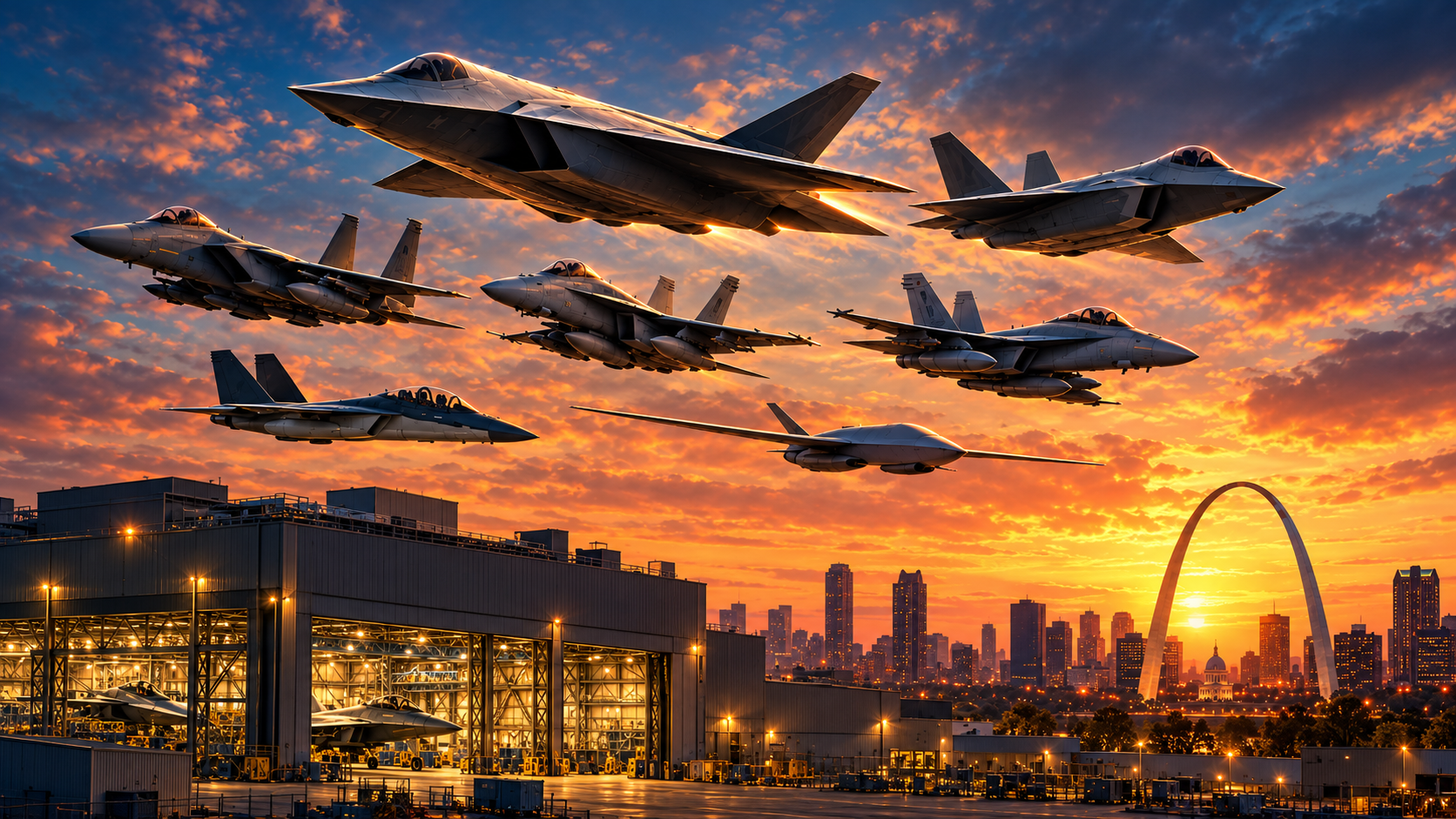
How St. Louis Missouri became the centre of America’s next generation of air power
For much of the past decade, the future of fighter production in St. Louis and the surrounding region looked less secure than its history might have suggested. The city had built some of the most important combat aircraft in American aviation, but as older programmes matured and production lines approached their eventual end, a reasonable question hung over the region: what would come next? Boeing’s victory in the U.S. Navy’s competition to develop the F/A-XX offers a rather emphatic answer.
The initial development contract is worth roughly $20bn and gives Boeing responsibility for the Navy’s next-generation carrier fighter, which is expected eventually to replace the F/A-18E/F Super Hornet. More significant than the size of the award, however, is the concentration of future combat-aircraft work it creates in St. Louis. Boeing already holds the Air Force’s F-47 programme, making the company responsible for developing both of America’s sixth-generation fighter aircraft. Alongside those programmes sit continuing F-15 production and modernisation, the final years of Super Hornet production, the EA-18G Growler, the T-7A Red Hawk training aircraft and the MQ-25 Stingray autonomous tanker. An old nickname now looks less like boosterism and more like a description of economic reality: St. Louis is Fighterland USA.
The pairing of F-47 and F/A-XX is the most consequential part of that story. In March 2025 the Air Force selected Boeing to develop the F-47 under its Next Generation Air Dominance effort. The Navy has now entrusted Boeing with the aircraft intended to define the future of carrier-based tactical aviation. That gives one company, and one unusually concentrated aerospace community, a central role in shaping the next generation of American combat air power. It is a remarkable reversal for a fighter business that, not long ago, faced persistent questions about what would happen once the F-15 and Super Hornet lines eventually ran their course.
The answer, it seems, is that St. Louis will build their successors. That is particularly striking in naval aviation, where the lineage is unusually clear. The original F/A-18 Hornet emerged from McDonnell Douglas in St. Louis and was followed by the larger and more capable Super Hornet, which became the backbone of the Navy’s carrier air wing, and by the EA-18G Growler, its electronic-attack derivative. The final batch of new-build Super Hornets is expected to keep the St. Louis production line active into 2027, while the aircraft themselves are expected to remain in service well into the 2040s. F/A-XX therefore does not represent a new relationship between St. Louis and naval aviation so much as the continuation of a very old one into another technological generation.
The same is true, in a different way, of the F-15. The aircraft first flew more than half a century ago, but the latest F-15EX Eagle II is a substantially modernised machine and remains in production. The Air Force’s recent Eagle Crest indefinite-delivery, indefinite-quantity contract has a ceiling of $131.23bn and can support production, modernisation and sustainment work through 2037. That figure is a maximum contractual value rather than guaranteed spending, but the duration matters. St. Louis is not simply waiting for sixth-generation programmes to mature; it continues to build and support one of the most capable fourth-generation-plus fighters in service.
Then there is the T-7A Red Hawk. It is not a combat aircraft, but it belongs in the same industrial story because it will train the pilots who operate America’s future fighters and bombers. The programme has moved into low-rate production, with major work centred in St. Louis, and it has also acquired a potentially important transatlantic dimension. BAE Systems, Boeing and Saab are offering a T-7-based system for Britain’s future fast-jet training requirement, with proposed British final assembly and substantial U.K. industrial participation. That creates an unusually coherent U.K.–Missouri relationship: a training system developed through the St. Louis aerospace ecosystem could help prepare Royal Air Force pilots for the next generation of combat aviation.
The MQ-25 Stingray points to another part of that future. The Navy has now placed the autonomous carrier-based tanker into low-rate production, with Boeing receiving a $562m award for the first production aircraft and long-lead work on additional units. MQ-25 matters because it shows how the carrier air wing is changing. Future air power will not consist simply of more advanced piloted fighters. It will combine crewed aircraft, autonomous systems, networked sensors, electronic warfare and increasingly sophisticated software. In that respect, St. Louis is not merely a fighter-production centre. It is becoming an important node in the broader transition toward integrated and increasingly autonomous air combat.
That is where the economic-development significance becomes larger than the individual programmes. Two sixth-generation fighters will require enormous amounts of engineering, software, advanced materials, electronics, secure manufacturing, sensors, artificial intelligence, propulsion technology and specialised labour. The question for Missouri is therefore not merely how many workers Boeing itself will employ. It is how much of the industrial ecosystem surrounding those programmes the state can capture.
The opportunity is substantial. Missouri can recruit suppliers, expand advanced-manufacturing capacity, deepen the pipeline of engineers and skilled trades, connect major programmes with institutions such as AMIC-STL and use the region’s geospatial expertise around the National Geospatial-Intelligence Agency to attract firms working in sensors, data, artificial intelligence and autonomy. If it does so successfully, the value of F-47 and F/A-XX will extend far beyond Boeing’s own payroll and into a much broader cluster of companies and capabilities.
That is what distinguishes a cluster from a collection of contracts. St. Louis now has F-15 production and modernisation, the closing chapter of the Super Hornet line, the Growler, the T-7, the MQ-25, the F-47 and the F/A-XX, all supported by Phantom Works, advanced weapons programmes, digital engineering, stealth expertise and generations of institutional knowledge inherited from McDonnell Aircraft and McDonnell Douglas. Few regions can claim comparable continuity across so many generations of tactical aviation.
For years, St. Louis has sometimes been described as an old aerospace city, a place whose greatest aviation achievements belonged to another era. The recent run of programmes suggests almost the opposite. Its industrial heritage may have given it precisely the engineering culture, workforce and institutional depth required for the next era of air power.
F/A-XX does not create Fighterland. It confirms it.
Leave a Reply
You must be logged in to post a comment.