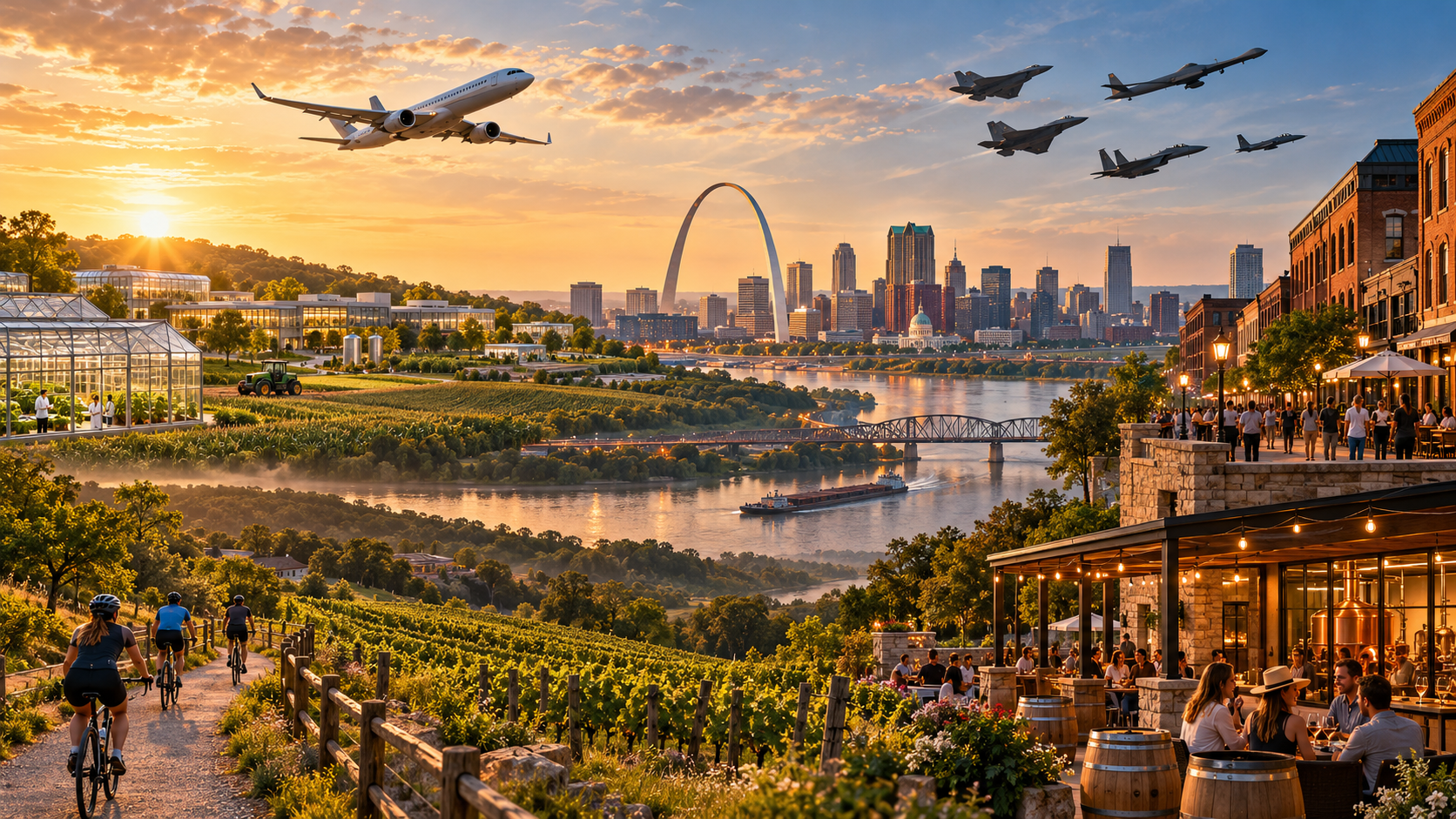
Something is quietly happening in Missouri.
There has not been one announcement big enough to define it. Instead, there are signs appearing across the state: new international flights, enormous aerospace contracts, a more coordinated agricultural-technology sector, new businesses opening in small communities and renewed investment in urban neighborhoods.
Individually, they are good stories. Together, they suggest Missouri may be entering a more consequential period of growth.
Start with the airport.
For nearly two decades, St. Louis had no nonstop passenger service to Europe. Today, Lufthansa flies to Frankfurt and British Airways flies to London Heathrow. British Airways has already announced an 80% increase in St. Louis capacity for 2027.
Now Icelandair is joining them, with nonstop service between St. Louis and Reykjavík beginning next May and connections onward to more than 35 European destinations.
St. Louis has gone from no nonstop European passenger service to three European airlines.
That is not merely a tourism story. International air service is economic infrastructure. It makes Missouri easier to reach for investors, executives, researchers and companies deciding where to locate operations. It also makes it easier for Missourians to reach markets overseas.
At almost the same time, something remarkable is happening in aerospace.
Boeing’s St. Louis operation has been selected to develop both of America’s next-generation fighter programs: the Air Force’s F-47 and the Navy’s F/A-XX. Those programs join continuing work on the F-15, T-7 trainer and MQ-25 autonomous tanker, together with the region’s long history producing the F/A-18 and EA-18G.
The opportunity is much larger than additional jobs at Boeing.
These programs will require suppliers, engineers, advanced manufacturing, software, artificial intelligence, sensors, materials and skilled trades. Missouri has an opportunity to build an entire next-generation airpower cluster around work that could continue for decades.
Agriculture is undergoing a similar change.
Missouri has always been an agricultural state. Increasingly, agriculture also means plant science, genetics, biotechnology, robotics, data and precision agriculture.
St. Louis already has one of America’s strongest concentrations of agricultural technology around 39 North, Bayer Crop Science, the Donald Danforth Plant Science Center and a growing collection of startups and research organizations.
Now Greater St. Louis and 39 North are formally coordinating their economic-development efforts.
That matters because successful economic clusters rarely come from one company or institution. They develop when companies, universities, research organizations, investors and economic-development groups begin pulling in the same direction.
But perhaps the more interesting signs of change are happening at a much smaller scale.
Look at Washington Avenue
Washington Avenue has had its share of difficult headlines over the years. What receives less attention is how much residential life has taken hold there.
Residential properties in the district are now reporting occupancy above 95%, creating a substantial population already living in the neighborhood. The broader Wash Ave district includes thousands of apartments and condominiums, hotels, restaurants, entertainment venues and hundreds of thousands of square feet of retail space.
And new investment continues.
Cordovan on the Park is bringing another 74 renovated apartments to 13th and Washington. Coffeestamp has opened its third St. Louis café at 1228 Washington. The Moniker has opened nearby. Freedom Technology Solutions has moved approximately 50 employees into the Globe Building. New retail and service businesses are filling storefronts, while additional residential development is underway elsewhere in the neighborhood.
Then there is Wash Ave Food Hall, preparing to open at 1122 Washington Avenue.
Rather than another single restaurant, it is being built as a collection of local concepts and a social destination. The announced lineup includes Arzola’s Tacos y Más, Steve’s Smash – Burgers & Fries, Troit, Little BAO, Macis’ Prime BBQ, Conefection and 4 Hands Brewing, with additional food and beverage offerings planned. The project will also include bars, self-pour taps, shared seating, events and Wash Ave Social, with indoor turf lawns and games such as cornhole, bocce and putting.
Nearby, the former Last Hotel is reopening as a Hyatt Centric.
None of these projects alone fixes Downtown St. Louis.
That misses the point.
A neighborhood changes when people live there, businesses serve them, restaurants give them somewhere to go, hotels bring visitors, offices bring workers and events put people on the sidewalks.
Washington Avenue is beginning to build that ecosystem again.
Then look at Defiance
Travel about 40 miles west and another version of the same story is happening on an entirely different scale.
Defiance has long benefited from Missouri wine country, the Katy Trail and the surrounding hills and vineyards. But the community is increasingly developing into a destination in its own right.
At Stone Ledge Distillery, we have watched that happen firsthand.
And we are far from alone.
Circle 6 Market & Watering Hole opened as a combination market, restaurant, music venue and gathering place, with direct access toward the Katy Trail. Its owners deliberately built it around both the local community and visitors coming into Defiance.
Saddles Social House followed, adding another place for food, drinks, outdoor gathering and even overnight accommodation for visitors and Katy Trail riders. It opened in late 2025.
Defiance Roadhouse has reopened under new, dynamic ownership, after being closed for almost two years, giving us another restaurant, bar and entertainment option.
And at Stone Ledge Distillery, we have continued developing the historic 1880 property as a whiskey and cocktail destination, with the distillery, cocktail and martini lounge, cigar room, outdoor patio, live music and events.
Those businesses join established destinations including Chandler Hill Vineyards, Defiance Ridge Vineyards, Sugar Creek Winery and Good News Brewing & Distilling. They are increasingly working together through community events such as Defiance Oktoberfest, which continues throughout October.
Again, none of these businesses alone changes the economy of St. Charles County.
Together, they change the reason someone comes to Defiance.
Instead of visiting one winery and driving home, someone can ride the Katy Trail, have lunch, visit a winery, drink Missouri whiskey, hear live music, have dinner and stay overnight.
That creates something more valuable than an individual attraction.
It creates a destination.
And that connects directly back to those new international flights.
A British visitor arriving nonstop from London does not have to spend an entire Missouri trip in Downtown St. Louis. They can stay in the city, explore Washington Avenue, travel into Missouri wine country and Defiance, ride part of the Katy Trail, experience Route 66 and continue toward the Ozarks and Branson.
Suddenly, these seemingly unrelated developments begin to connect.
International flights bring the world closer.
Aerospace creates advanced manufacturing and high-skilled jobs.
Agritech connects one of Missouri’s oldest industries to some of its newest technologies.
Neighborhoods such as Wash Ave are becoming places to live, eat, stay and gather again.
Communities such as Defiance are turning local businesses, landscape and character into tourism economies.
That is the bigger Missouri story.
The state does not need to become something entirely different to succeed. In many cases, it needs to take the things it has always done well—agriculture, manufacturing, aviation, hospitality, small towns and distinctive neighborhoods—and connect them to the economy of the future.
There are still plenty of challenges. Downtown St. Louis is not fixed. Major aerospace contracts still need to translate into Missouri suppliers and jobs. International flights have to remain successful. Small businesses still operate on difficult margins. Economic-development announcements still have to become lasting economic activity.
But momentum often begins this way.
Not with one ribbon cutting or one billion-dollar announcement, but with a series of developments that at first appear unrelated.
A new international route.
A fighter contract.
An agritech partnership.
A full apartment building.
A coffee shop opening on Washington Avenue.
A new restaurant in Defiance.
One by one, they are small pieces.
Put together, they begin to look like something else.
Quietly, Missouri may be building the next version of itself.
Leave a Reply
You must be logged in to post a comment.