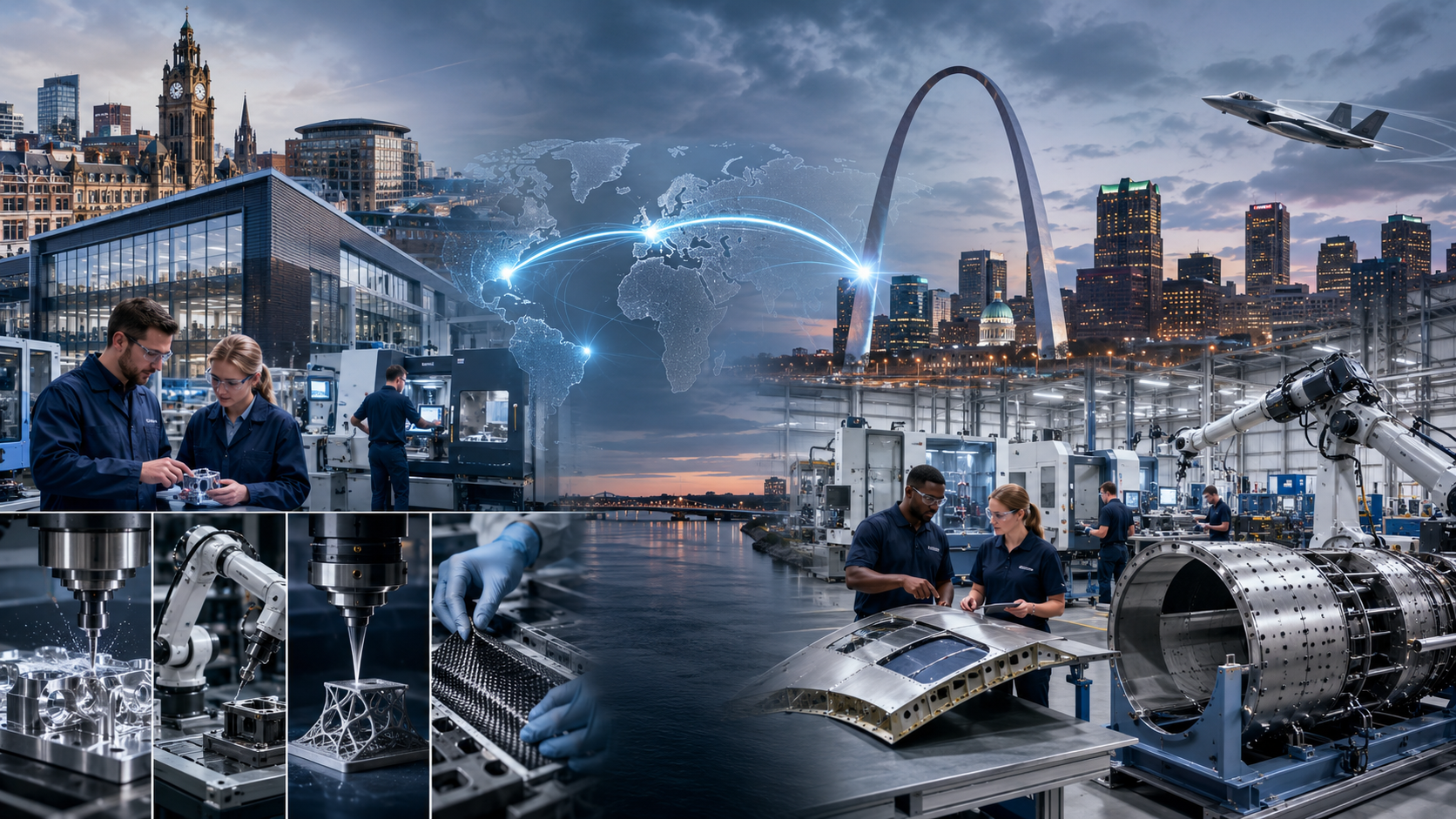
St. Louis has no shortage of economic-development projects. The Advanced Manufacturing Innovation Center St. Louis is different because it is not primarily about real estate, incentives or even job creation. It is about whether the region can retain the industrial capabilities needed to compete in the next generation of advanced manufacturing.
That question is becoming increasingly important.
As reported on ManufacturingDive.com, AMIC’s first major facility is under construction in north St. Louis, with its approximately 52,000-square-foot first phase expected to open in early 2027. Boeing is a major partner, universities and workforce institutions are involved, and programming is already underway.
The timing is unusually good. Boeing is producing and developing the F-15EX, T-7A Red Hawk and MQ-25 Stingray in the region, while its St. Louis operation is also leading development of the F-47, the Air Force’s next-generation fighter. The company is simultaneously making substantial investments in Missouri facilities supporting digital engineering, development and future production.
AMIC sits squarely within that transition.
It also has a distinctly British pedigree.
A model imported from Sheffield
AMIC–STL was modeled in important respects on the University of Sheffield Advanced Manufacturing Research Centre in England, which Boeing helped establish as a founding industrial partner in 2001.
The idea was practical rather than academic: bring manufacturers, universities and engineers together to test technologies, improve production methods and solve problems that companies might struggle to address alone.
The model worked.
Boeing’s collaboration with the AMRC helped develop new machining techniques and production systems and contributed to the case for Boeing Sheffield, the company’s first manufacturing facility in Europe.
That is the important lesson for St. Louis. Sheffield demonstrated that manufacturing research can lead to production capability, and that production capability can influence where companies invest.
More than two decades later, the relationship remains active. Sheffield’s new £54 million COMPASS facility is supporting Boeing-backed work on advanced methods for producing large composite aerospace structures and other technologies likely to shape future aircraft production.
In other words, the model St. Louis is borrowing has already been tested.
The British connection is already more than symbolic
The relationship between Sheffield and St. Louis has also moved beyond institutional genealogy.
South Yorkshire Mayor Oliver Coppard led a delegation to Missouri that included representatives of the University of Sheffield, Sheffield Hallam University, the Sheffield Chamber of Commerce and other regional organizations, with a focus on building stronger economic and innovation ties with St. Louis.
Members of Parliament have also visited AMIC through the British-American Parliamentary Group as part of broader discussions involving defense, geospatial technology, research and economic development.
British diplomatic officials, including representatives of the British Consulate-General in Chicago including the Deputy Consul General, have participated as well.
Those visits are worth noting because they give the relationship substance. AMIC is increasingly connected not merely to Sheffield’s manufacturing model, but to British political, diplomatic, university and business institutions.
That creates a useful foundation for something more durable.
Why AMIC matters to Missouri
Advanced manufacturing is becoming more capital-intensive and more technically demanding. Digital engineering, robotics, automation, additive manufacturing, advanced composites and sophisticated production systems are no longer peripheral technologies. In sectors such as aerospace, they are becoming central to competitiveness.
For St. Louis, the question is not whether the region knows how to manufacture aircraft. Its history answers that.
The more relevant question is whether St. Louis can keep pace with how aircraft and other complex products will be manufactured in the future.
AMIC gives companies a shared environment in which to test new processes, develop prototypes and evaluate technologies without having to carry the full cost and risk on their own.
That may matter most for smaller and midsized manufacturers.
Boeing can support extensive research and engineering operations internally. Many suppliers cannot. Yet those smaller companies remain essential to the aerospace, defense, automotive, medical and industrial supply chains.
If AMIC allows a Missouri manufacturer to test automation before purchasing it, improve a production process, reduce waste or develop a capability that helps it win work on a major program, its value is straightforward and measurable.
The Sheffield model has endured because it addressed industrial problems rather than merely talking about innovation. AMIC will ultimately be judged the same way.
The workforce challenge
Technology is only part of the equation.
Advanced manufacturing requires a workforce capable of using it, and that is becoming one of the larger constraints on industrial growth.
Modern manufacturing depends on engineers and scientists, but also machinists, robotics technicians, welders, programmers, materials specialists and workers capable of operating increasingly sophisticated equipment.
AMIC is positioned between industry and that workforce pipeline.
Its location near Ranken Technical College is significant, and student programs involving collaborative robotics, additive manufacturing and advanced welding have already taken place before the new facility has opened.
That matters because workforce availability has become part of the location decision for almost every serious manufacturing investment. Companies want to know not merely whether a region has land, infrastructure and incentives, but whether it will still have the people required to operate a plant ten or twenty years from now.
AMIC strengthens St. Louis’ answer.
A practical U.K.–Missouri economic connection
The relationship between Missouri and the United Kingdom is also becoming more substantial.
There are existing ties in aerospace and defense, regular political and diplomatic engagement, increasing business activity and now direct air service between St. Louis and London.
AMIC adds something more useful than symbolism: an institution around which commercial relationships can form.
The ingredients are already in place. The University of Sheffield helped provide the model. Boeing has deep operations in both Sheffield and St. Louis. Mayor Oliver Coppard and Sheffield regional leaders have visited Missouri. Members of Parliament have toured AMIC. The British Deputy Consul General and other diplomatic officials have participated in the relationship.
That creates an obvious platform for research collaboration, business introductions, technical exchanges and stronger links between British and Missouri manufacturers.
It does not require inventing a new relationship. It requires making better use of one that already exists.
The real test
When AMIC opens in 2027, the building itself will attract attention. That will be the least interesting measure of its success.
The important questions will be whether manufacturers become more productive, suppliers become more competitive, workers gain skills employers actually need and new investment follows.
The foundation is already unusually strong.
A proven British manufacturing model has been brought to St. Louis. Boeing, which helped establish that model in Sheffield, is supporting its Missouri counterpart. British political and diplomatic leaders are already engaged. Universities, technical institutions and manufacturers are involved. And the facility is being built at precisely the moment Boeing is preparing some of its most important future aerospace programs in Missouri.
AMIC will not determine the future of St. Louis manufacturing on its own. But it addresses several of the things that will: technology, productivity, workforce and access to industrial research.
That is why it matters.
And it may also become one of the more consequential economic links between Missouri and the United Kingdom—not because it represents the relationship, but because it gives both sides something useful to do together.