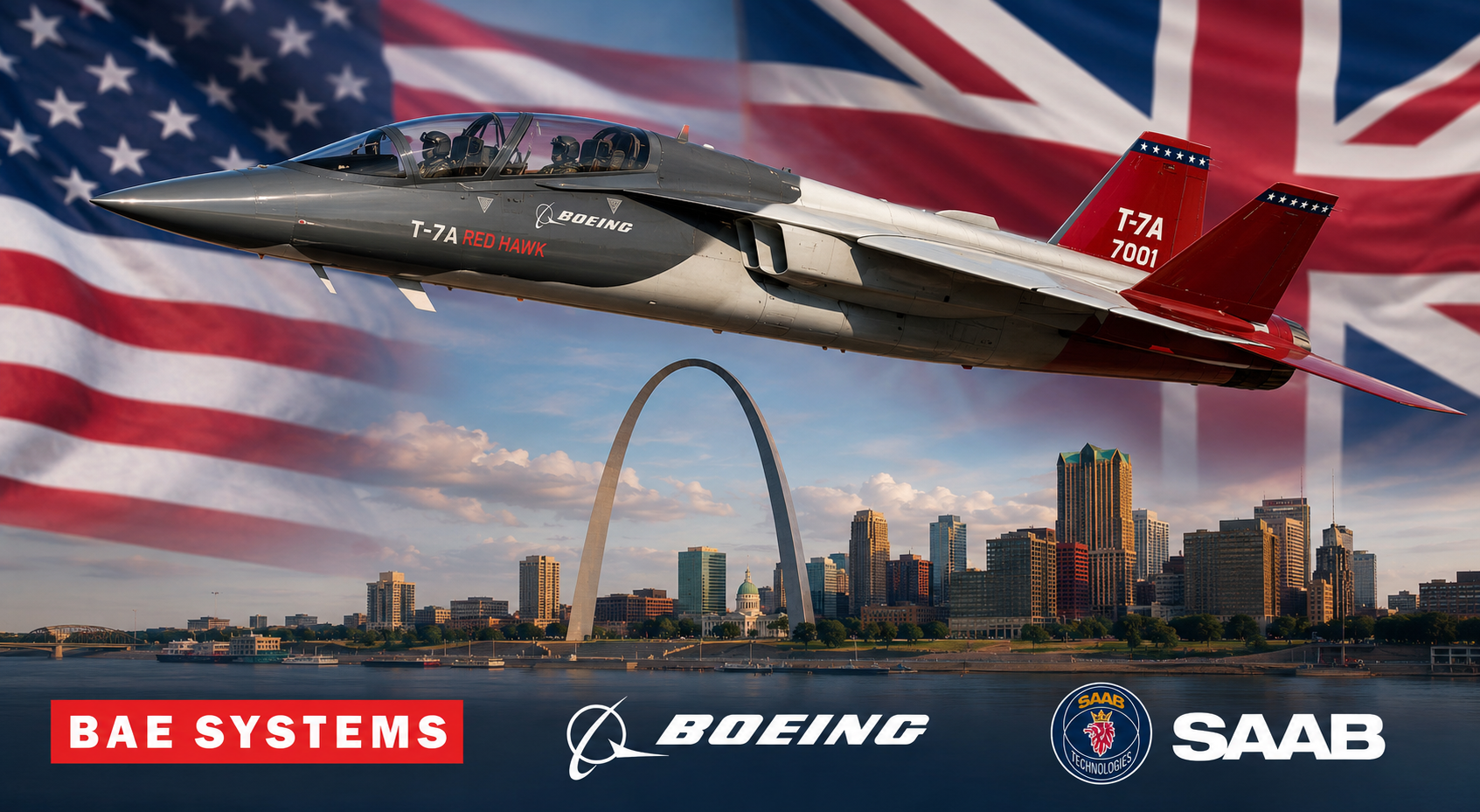
I recently had the privilege of writing an opinion piece for the St. Louis Business Journal about an opportunity that sits at the intersection of two subjects that are especially important to me: the growing relationship between Missouri and the United Kingdom, and St. Louis’ extraordinary role in military aviation.
Britain is preparing for the eventual replacement of the Royal Air Force’s Hawk trainer, and BAE Systems, Boeing and Saab have joined forces around a proposal built on the T-7. With the T-7’s American production line here in St. Louis, the competition represents much more than an aircraft sale. It is an opportunity to deepen the defense and industrial relationship between Missouri and the United Kingdom while strengthening allied air power for the next generation.
Below is the piece as it appeared in the St. Louis Business Journal on July 30, 2026.
Britain needs a new jet trainer. Missouri may help provide it.
BAE Systems, Boeing and Saab have formalized a partnership to offer the United Kingdom a next-generation pilot-training system built around the T-7. The proposal would replace the Royal Air Force’s aging Hawk trainers while creating a British final-assembly and integration facility.
For the United Kingdom, the decision is about more than choosing an aircraft. It is about rebuilding a training system capable of preparing pilots for the Typhoon, F-35 and the future Global Combat Air Programme fighter. It is also about preserving sovereign industrial capacity, supporting the Red Arrows and strengthening Britain’s ability to train more pilots at a time when NATO needs greater readiness.
For Missouri, the significance is equally clear. The T-7 Red Hawk was developed by Boeing and Saab, and its American production line is in St. Louis. The aircraft is part of a much larger defense-aerospace ecosystem that has made Missouri one of the world’s most important centers for military aviation.
A British selection would not simply export a Missouri-built aircraft. The companies are proposing substantial work in the United Kingdom, including final assembly, integration, training and support. That is politically and strategically necessary. Britain wants a sovereign capability, not an off-the-shelf foreign purchase.
But the value to Missouri remains considerable. A U.K. program would deepen the international customer base for an aircraft whose engineering, production expertise and supply-chain foundation are rooted in St. Louis. It could extend the program’s life, support future upgrades and improve its prospects with other allied air forces facing similar training requirements.
It would also reinforce a broader lesson for Missouri’s economy. Defense manufacturing is no longer sustained only by large domestic orders. Long-term growth increasingly depends upon allied programs, shared supply chains and exportable platforms. Winning in Britain could therefore create opportunities far beyond this single competition.
This is how successful defense partnerships increasingly work. Nations want domestic jobs and control over critical capabilities, while modern aircraft programs require shared technology, production and expertise. Missouri and the United Kingdom need not compete for every piece of the work. They can build a transatlantic industrial partnership around complementary strengths.
The team is formidable. BAE Systems built the Hawk and understands the RAF’s training requirements. Boeing brings the T-7 platform and St. Louis production base. Saab helped develop the aircraft through a digital-design process intended to reduce development time and make future modifications easier.
They will face competition, and Britain has not yet selected a replacement. Cost, delivery schedule, domestic content and long-term training performance will matter. The winning proposal must offer more than a good jet. It must provide an integrated system combining aircraft, simulators, courseware, maintenance and the capacity to evolve as combat aviation changes.
Missouri should recognize the opportunity and actively support it. State leaders, the congressional delegation and the region’s business organizations should make clear that St. Louis is ready to help Britain build a modern training capability while expanding a trusted defense relationship.
The foundation for that relationship already exists. Missouri is home to the nation’s first state-level Friends of the United Kingdom Caucus, reflecting a bipartisan commitment to strengthening ties with one of America’s closest allies. During the 2026 FIFA World Cup, Missouri also served as the home base for England’s national team, further strengthening people-to-people connections between our two nations. Those cultural ties are matched by deep economic links, with British companies investing across Missouri and Missouri businesses partnering with the UK in aerospace, advanced manufacturing, financial services and life sciences.
The Hawk became one of Britain’s most recognizable aircraft. Its replacement is a test of how allies build the future together. Choosing the T-7 would not just deliver a new trainer—it would bind British capability and Missouri innovation into a shared system of air power. That is the real opportunity: not just a better aircraft, but a stronger alliance built to meet the challenges ahead.
Originally published in the St. Louis Business Journal on July 30, 2026.
Mark Sutherland is the British Honorary Consul to Missouri and CEO of Stone Ledge Distillery in Defiance.