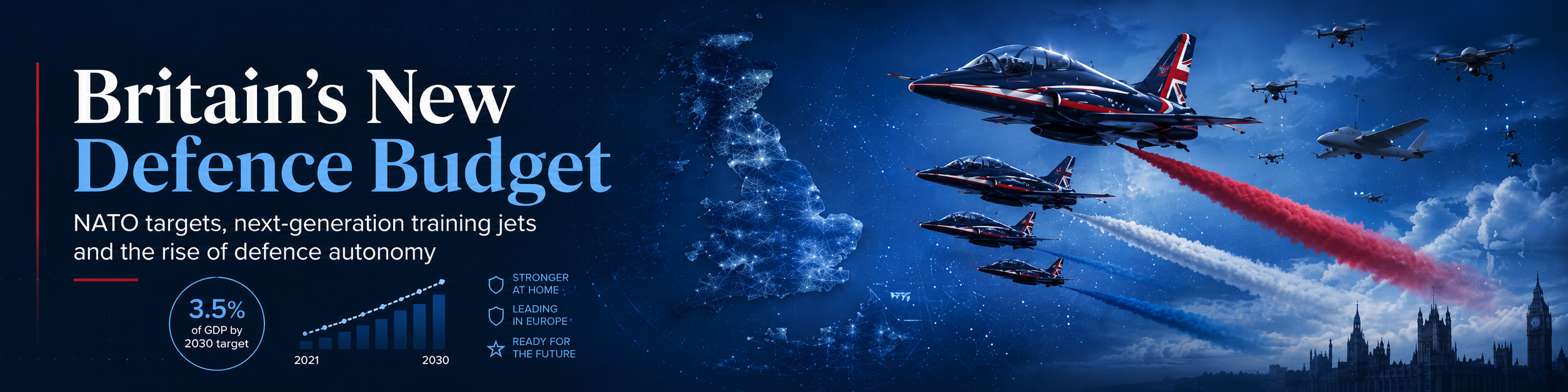
The United Kingdom’s new Defence Investment Plan arrives at a serious moment for Britain, NATO and the wider democratic world. War in Europe, instability in the Middle East, rising cyber threats and the rapid evolution of drone warfare have all made one point unmistakably clear: deterrence must be credible, modern and properly funded.
For those of us who care deeply about the strength of the UK, the United States and NATO, the plan is encouraging. It is not perfect, and there will rightly be debate over whether it goes far enough. But it does represent a significant recognition that defence can no longer be treated as a secondary priority. The UK government has committed nearly £300 billion in defence spending through 2029/30, including an additional £15 billion over the next four years. The plan also recommits Britain to increasing defence spending to 3% of GDP in the next Parliament and to working with NATO allies toward the newer 3.5% GDP defence spending target by 2035.
That NATO funding target matters. It is more than an accounting exercise. It is a signal to adversaries that the Alliance understands the world has changed and that free nations are prepared to invest in their own defence. It is also a message to allies that Britain intends to remain a serious military power, not only through its nuclear deterrent and expeditionary capabilities, but through modern technology, industrial capacity and readiness.
One of the most interesting elements of the plan is its focus on the future of air power. The Defence Investment Plan includes new jets for a modernised fast-jet training system, which will also allow the Red Arrows to replace their ageing Hawk aircraft. The plan specifically references significant UK workshare, but does not yet name the aircraft.
That opens an intriguing possibility. One of the aircraft being discussed as a potential Hawk replacement is the Boeing-Saab T-7 Red Hawk, which has strong Missouri ties. Boeing has confirmed that T-7A production continues at its St. Louis, Missouri site, and the aircraft has become an important part of the region’s advanced aerospace manufacturing base. Aviation Week has reported that BAE Systems is prepared to perform final assembly and development work in the UK if the Boeing-Saab platform is selected for the RAF Hawk replacement programme.
That would be a powerful example of what modern defence cooperation can look like: a Missouri-designed and Missouri-built aircraft concept supporting British training needs, while also being adapted and built in the UK to strengthen British jobs, skills and sovereign industrial capability. For Missouri, it would be another reminder that our aerospace sector is not only important to the United States, but also to our closest allies. For the UK, it would provide a pathway to modern training aircraft while reinforcing the domestic defence industrial base.
The other major signal in the budget is the commitment to drones, autonomy and uncrewed systems. The government has announced more than £5 billion over the next four years for what it describes as the largest-ever drone investment in the UK Armed Forces. This includes attack drones, autonomous systems, uncrewed vessels, a new Uncrewed Systems Centre in Swindon and a taskforce designed to move new autonomous capabilities from industry into the hands of the Armed Forces more quickly.
This is exactly the kind of area where emerging defence technology companies should be paying close attention. Systems like Swarmer, and other platforms focused on drone coordination, autonomous mission planning, battlefield resilience and scalable low-cost hardware, fit directly into the direction of travel. The UK is not simply buying traditional platforms; it is trying to build a defence ecosystem that can innovate at speed. The lesson from Ukraine has been unmistakable: the side that can adapt, iterate and deploy new technology faster has a decisive advantage.
The plan also includes investment in Collaborative Combat Aircraft, autonomous fighter concepts, uncrewed ground vehicles, Project NYX armed drones, Project Corvus surveillance drones and systems such as Storm Shroud, the uncrewed electronic warfare drone expected to enter service this year. In practical terms, that means Britain is looking across the full spectrum: air, land, sea, cyber, electromagnetic warfare and AI-enabled operations.
There will be fair questions about affordability, delivery timelines and whether the UK is moving quickly enough. Funding targets must become funded programmes. Industrial strategy must become production capacity. Procurement reform must become faster decisions. But the direction is right.
Britain is at its best when it combines global leadership, serious defence commitments, innovation and industrial strength. This Defence Investment Plan is an opportunity to do exactly that. It strengthens NATO, supports British industry, creates opportunities for trusted allies and sends a clear message that deterrence in the modern era must be both technologically advanced and economically grounded.
For Missouri, there is also a clear takeaway. Our aerospace, defence and advanced manufacturing sectors are part of a much larger allied security network. Whether through aircraft like the T-7, autonomous systems, drone technology or future defence partnerships, Missouri has a role to play in helping the UK, the United States and NATO meet this moment.